

W ith record participation, strong institutional presence and substantial dialogue on infrastructure, investment, digital transition and human capital, the 5th Panhellenic Yachting Congress confirmed that Greek yachting is entering a more mature phase of strategic planning.

Vasilis Dragnis & K. Giannis Dragnis / Golden Yachts & Diamond Sponsor of the Congress, with Kalliopi Efstathiou – Trinity Events
The 5th Panhellenic Yachting Congress concluded with a strong impact on February 26 and 27, 2026, at the iconic Domus at Asteria Glyfada, bringing together the key forces shaping the future of Greek yachting. For two days, the sector’s centre of gravity shifted to the Athenian Riviera, where modern Greek maritime identity met international business momentum.
Organised by Kalliopi Efstathiou of Trinity Events and Anastasios Konstantaros of BoatsAdvisor Hub & Events, the congress once again confirmed its institutional role as Greece’s leading forum for dialogue on maritime tourism and professional yachting. Representatives of the State, the shipping and tourism industries, international investors, shipowners, brokers, shipbuilders, marina managers, designers, digital transformation experts and the new generation of industry professionals all contributed to a programme with clear strategic focus.

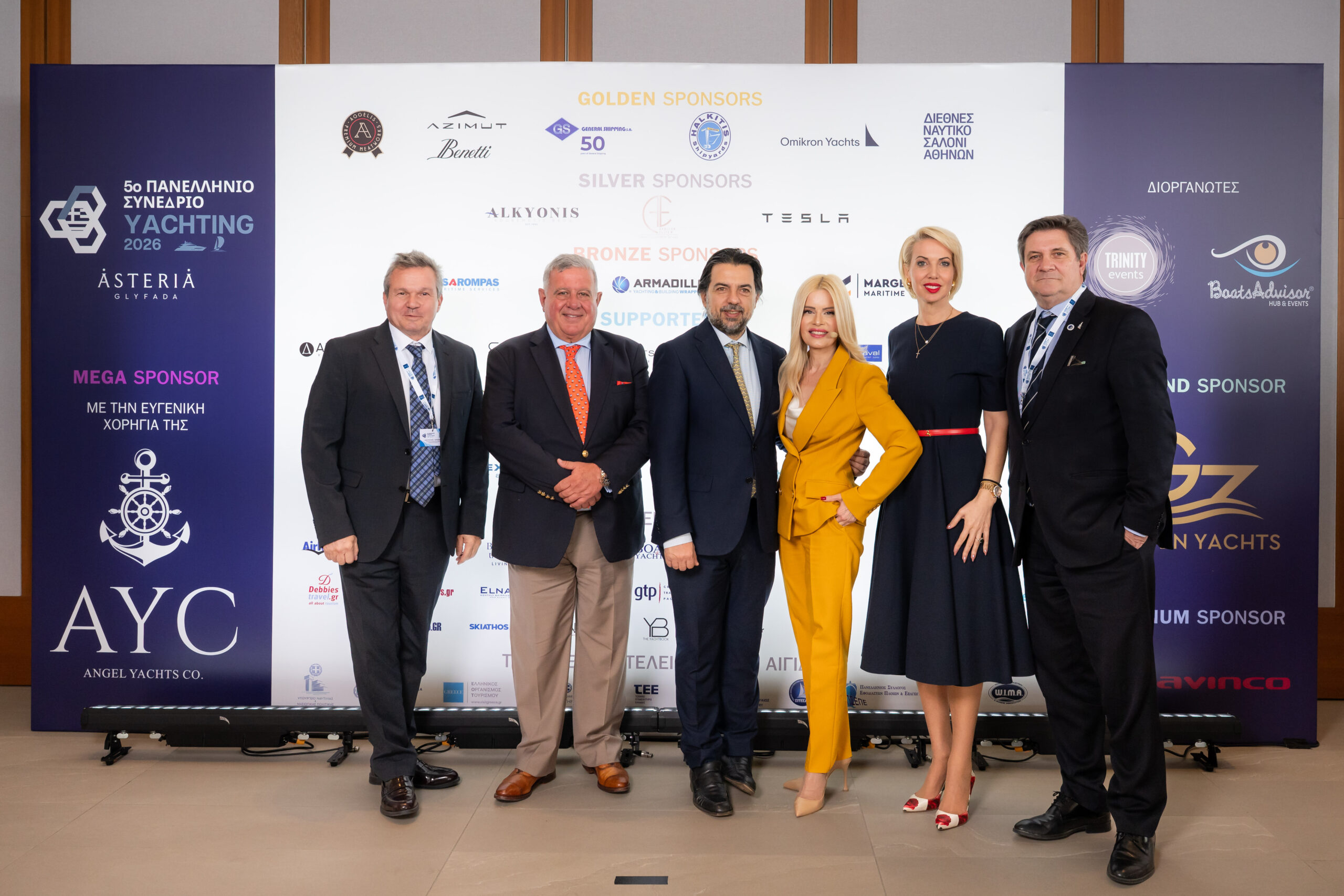
Dimitris Angelakos, Managing Director Angel Yachts & Mega Sponsor of the Congress, with Kalliopi Efstathiou – Trinity Events and Anastasios Konstantaros – BoatsAdvisor Hub & Events
Greece as a mature yachting hub
This year’s congress highlighted Greece’s increasingly prominent role on the global yachting map. The country is no longer seen solely as a privileged destination defined by natural beauty and an extensive island network. It is also emerging as a mature business hub that combines know-how, skilled human capital and growing investment momentum.
The presence of representatives from international shipbuilding groups, senior executives of financial institutions, maritime technology specialists, digital transformation experts, shipowners, captains, brokers, designers and professional crews underlined the fact that the Greek yachting ecosystem is now fully interconnected with international developments.
The two-day event served as a platform for the meaningful exchange of knowledge and experience, linking Greek practical expertise with international innovation. The agenda focused on modern marinas and new port infrastructure management models, innovative financing tools for vessels and infrastructure, the training of high-performance crews and the growing need for continuous education. Particular emphasis was placed on digital transition, the prevention of operational and regulatory risk, the strategic role of captains and younger professionals in shaping the future of the sector, as well as the expansion of high value-added services such as personalised concierge offerings and holistic health, wellness and fitness services that now accompany the experience of a modern luxury yacht.
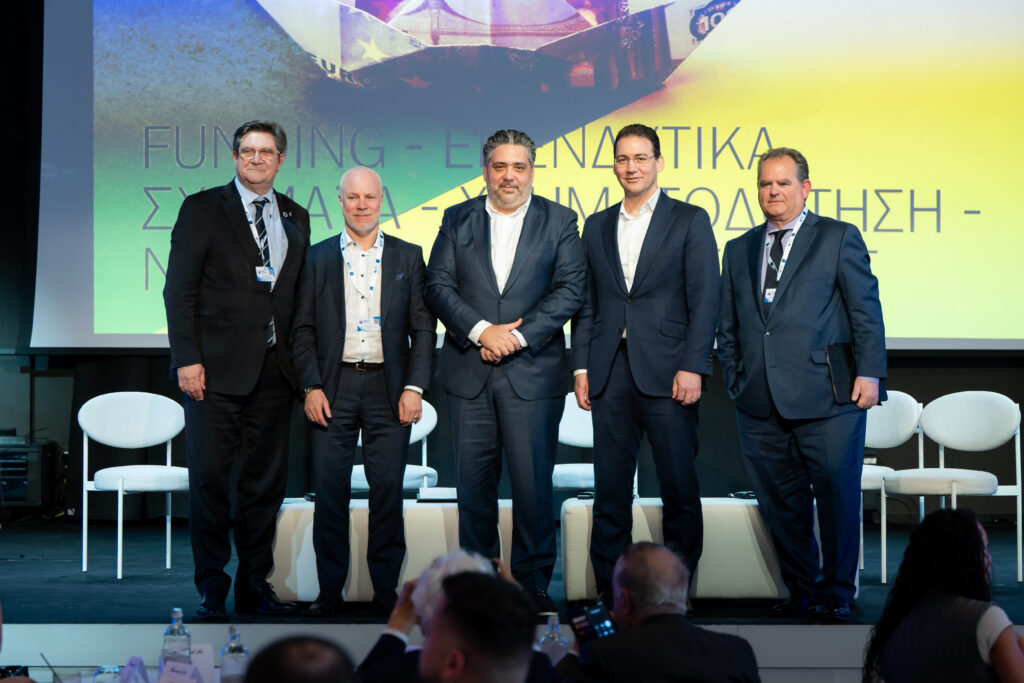
Panel: Funding – Investment Schemes
Institutional presence and political signals
The prestige of the event was also reflected in the level of institutional participation. Among those who addressed the congress were European Commissioner for Sustainable Transport and Tourism Apostolos Tzitzikostas, via video from Brussels, Deputy Minister of Shipping Stefanos Gikas, President of the Hellenic Chamber of Shipping George Alexandratos, and President of the Greek National Tourism Organization Angela Varela, who outlined the national tourism development strategy. A written greeting was also sent by US Ambassador to Greece Kimberly Guilfoyle, read on her behalf by Dimitris Angelakos, Managing Director of Angel Yachts and Mega Sponsor of the congress.
Their participation confirmed that yachting is now a priority not only for the private sector, but also within the broader framework of sustainable transport, tourism and investment planning. The active support of the Hellenic Chamber of Shipping was equally significant, with the Chamber playing an essential role in elevating key issues affecting the maritime tourism community.

The Congress presenter, journalist Vicky Hantzi, together with executives from the yachting industry
Infrastructure, marinas and a new development agenda
One of the congress’s most important announcements came from Deputy Minister Stefanos Gikas, who presented an extensive programme for the strengthening of port infrastructure. The plan includes the upgrade of 30 island ports, backed by a total budget of €260 million, with €180 million from the NSRF “Transport 2021-2027” and €80 million from the Recovery Fund.
The intervention is designed to improve functionality, safety and service quality, while simultaneously upgrading the operational environment for commercial recreational vessels and supporting the local economies and sustainable development of island regions.
At the same time, Gikas highlighted plans to create a strong maritime tourism hub in the Ionian Islands and northwestern Greece, with strategic investments in key locations including the marinas of Kefalonia, Lefkada, Igoumenitsa, the investment in Astakos, the Mega Yacht marina in Corfu, and the marinas of Imerolia, Spilia and Benitses. The broader objective is to transform the Ionian into a model region for yachting development, increase mooring capacity for large yachts and limit the outflow of maritime tourism to competing Mediterranean destinations.
 Greece as a premium destination and the role of digitalisation
From a tourism strategy perspective, Angela Varela presented plans for the systematic promotion of Greece as a premium yachting destination, not only in traditional markets such as Europe and North America, but also in emerging high-net-worth markets. Particular focus was placed on India’s ultra-wealthy segment, with direct flights from Delhi and Mumbai seen as opening new opportunities to attract affluent travellers seeking personalised luxury experiences in the Mediterranean.
Another key development is the creation of a unified digital platform by the Ministry of Tourism, which will bring together the country’s port infrastructure and allow visitors to make marina reservations in real time. The initiative is expected to increase transparency, facilitate charter planning and enhance the overall user experience, aligning Greece with international standards of digital service.
At the same time, the approval of 28 investment projects for the creation of new marinas was announced, reflecting both the strength of investor interest and the State’s intention to expand and modernise the network of infrastructure for recreational vessels.

Congress organisers – Anastasios Konstantaros (BoatsAdvisor Hub & Events) & Kalliopi Efstathiou (Trinity Events)
Tax clarity and strong market data
A further development of importance was the clarifying memorandum from the Hellenic Revenue Agency, which confirmed that VAT on the private use of recreational boats is set at 13%. The clarification provides a clearer and more predictable fiscal framework for boat owners and industry professionals, contributing to the stability of the business environment and improving transparency.
Official market data presented at the congress also reinforced the narrative of Greek leadership. According to the European Commission for Professional Yachting (ECPY) and the European Commission for Maritime Tourism, Greece recorded a 24% increase in demand in 2025, accounting for 40% of all bookings in the Eastern Mediterranean, ahead of Croatia at 22% and Turkey at 7%. The country also ranked second worldwide in recreational boat traffic and third in the Mediterranean for the number of superyachts above 24 metres.
These figures do more than confirm Greece’s strong position. They show that the country is evolving into a leading force in the Eastern Mediterranean, with the potential to consolidate its international influence even further.
 The next phase requires a strategic shift
Despite the sector’s strong recent performance, one of the clearest messages of the congress was that high demand alone is not enough to guarantee long-term leadership in maritime tourism. On the contrary, the current momentum creates the need for a substantial change of course in strategic planning, one that will allow Greece to safeguard its position against intensifying regional competition, capitalise on its geopolitical advantage of stability and security, and build a more resilient and sustainable development model.
Delegates broadly agreed that the future requires coordinated interventions across three critical pillars.
The first is infrastructure: the upgrade and modernisation of marinas and tourist shelters, the rationalisation of port fee pricing policies and the implementation of organised anchorages in sea parks and protected areas, so that environmental protection can work in tandem with chartering and sustainable local development rather than act as a deterrent.
The second is the institutional and tax framework: faster and simpler licensing procedures, a stable and internationally competitive tax environment, the full and effective operation of digital tools such as E-Charter, E-Immobility and E-Idle, the limitation of illegal chartering and a reduction in bureaucracy. The need for compensatory measures to support Greek businesses in the event of an extension of charter days for foreign professional recreational vessels through e-Charter Permission was also discussed.
The third is human resources and sustainable development: the creation of specialised yachting schools, modern training programmes, a parallel registry for the insurance of foreign crews from third countries in NAT, and equal recognition of previous service on private recreational vessels so that the sector’s existing experience and expertise can be fully utilised.
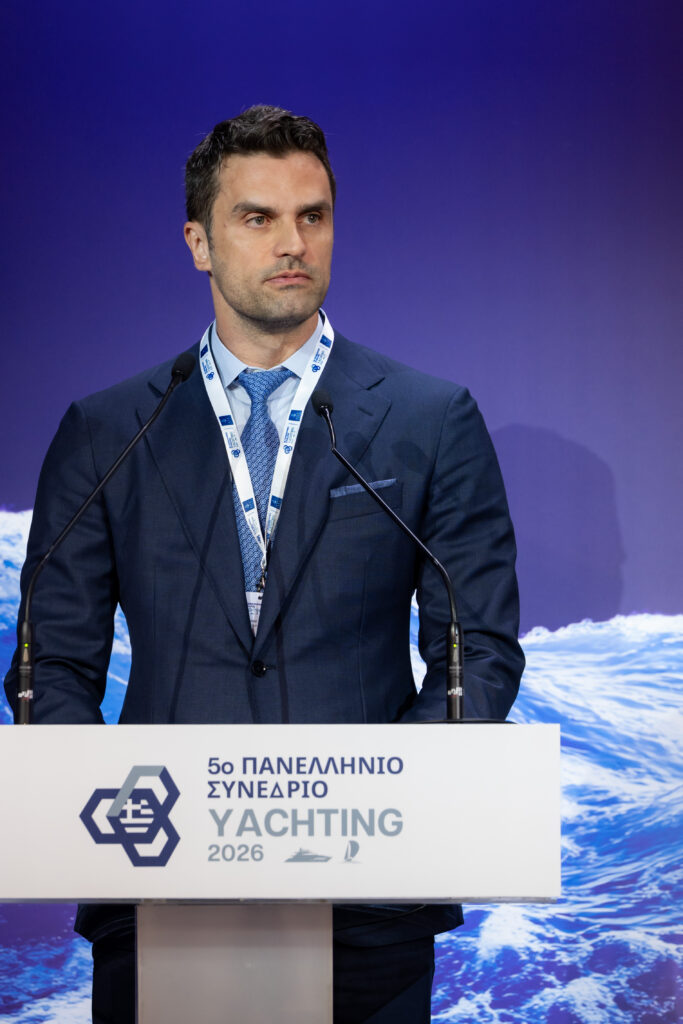
Vasilis Dragnis, CEO Golden Yachts & Diamond Sponsor of the Congress
More Greek flags in Greek seas
One of the most strategically significant themes of the congress was the strengthening of the Greek flag, with the slogan “More Greek flags in Greek seas” encapsulating the common will of institutional and business stakeholders. In an environment of intense international competition, flag choice is not merely a formality. It directly affects competitiveness, operating costs, investment attractiveness and the national added value generated by the sector.
In this context, the exchange of views between George Alexandratos, Admiral Vassilis Politis and prominent business figures active in the mega yacht charter market led to a proposal for a closed-door meeting with representatives of the Ministries of Shipping, Finance and Labour. The aim is to explore incentives that could encourage the re-registration of commercial vessels under the Greek flag and enhance the country’s international competitiveness in maritime tourism.

Dimitris Angelakos, Managing Director Angel Yachts & Mega Sponsor of the Congress, with Kalliopi Efstathiou – Trinity Events and Anastasios Konstantaros – BoatsAdvisor Hub & Events
The next generation and new thinking
The congress also drew special energy from the active participation of the new generation of yachting professionals. Designers, engineers, captains, lawyers, distinguished sailors and students from the National Technical University of Athens and the maritime studies programme of BCA College demonstrated that the sector has a strong pipeline of talent defined by expertise, creativity and international outlook.
These younger professionals did not attend merely as listeners. They took part as equal interlocutors, contributing ideas on innovation, technology, sustainable growth and the improvement of career opportunities in the sector.
The programme also featured a series of notable interventions, including Ioannis Patiniotis, founder and president of PYLI NET, who presented new tools for measuring, quantifying and verifying the value of human capital in yachting; Dimitris Randou, founder and CEO of Tallyboat Platform, who addressed the digitisation and simplification of workflows in yachting; and Anna Koutsokosta and Marina Filippidi of AMK Architecture & Design, who shared their holistic approach to boat design, drawing on years of experience across hospitality, cruise and yacht projects in Greece and abroad.
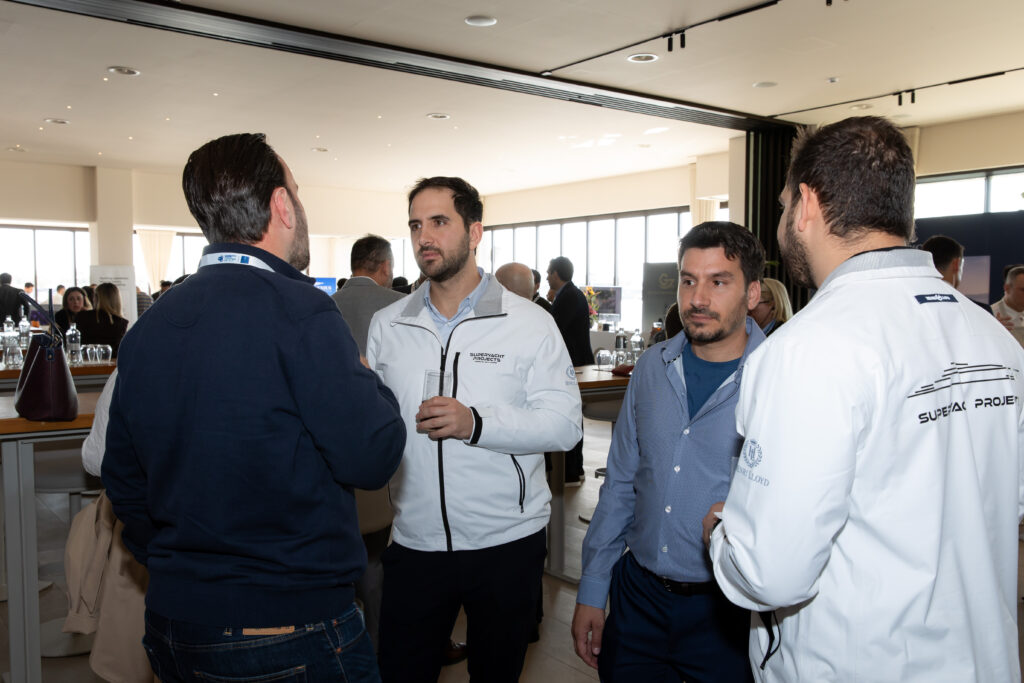 Sponsors, institutional support and the ecosystem behind the congress
The congress was held under the auspices of the Ministry of Shipping & Island Policy, the Ministry of Tourism, the Region of Attica, the Greek National Tourism Organization (EOT), the Hellenic Chamber of Shipping, the Technical Chamber of Greece, the Piraeus Chamber of Commerce and Industry, S.I.T.E.S.A.P., P.S.E.P.E., the Hellenic Committee for Professional Yachting (H.C.P.Y.) and the Worldwide Industrial & Marine Association (W.I.M.A.), whose institutional support added further weight to the event.
Sponsors also played a decisive role. Angel Yachts participated as Mega Sponsor, Golden Yachts as Diamond Sponsor, while Navinco supported the event as Platinum Sponsor. Golden Sponsors included Aggelis Premium Meatworks, Az Yachting Hellas AE / The Official Dealer of Azimut Yachts & Benetti Office in Greece, General Shipping, Halkitis Shipyards, Omikron Yachts and the Athens International Boat Show. Silver Sponsors were Alkyonis Kouremetis Bros, Apollon Elite Luxury Transportation Services and Tesla, while Bronze Sponsors included Argo Psarompas Maritime Services, Armadillo Yachting & Building Wrapping and Margetis Maritime.
Further support came from a broad network of Supporting Sponsors, Special Sponsors and Media Sponsors, who helped carry the congress’s messages across Greece and abroad. Among them was The Yachtbook, as Communication Sponsor of the event.
A strong closing message
The 5th Panhellenic Yachting Congress left behind a strong and substantial legacy. It highlighted opportunities, recorded challenges and, above all, created common ground for the sector’s next phase. In an increasingly competitive international environment, Greece demonstrated that it possesses not only natural advantages, but also the strategic will, institutional maturity and business momentum required to consolidate its role as a leading global maritime tourism destination.
The message from Domus at Asteria Glyfada was clear: today’s success is only a starting point. The next chapter for Greek yachting will require cooperation, planning and bold execution.